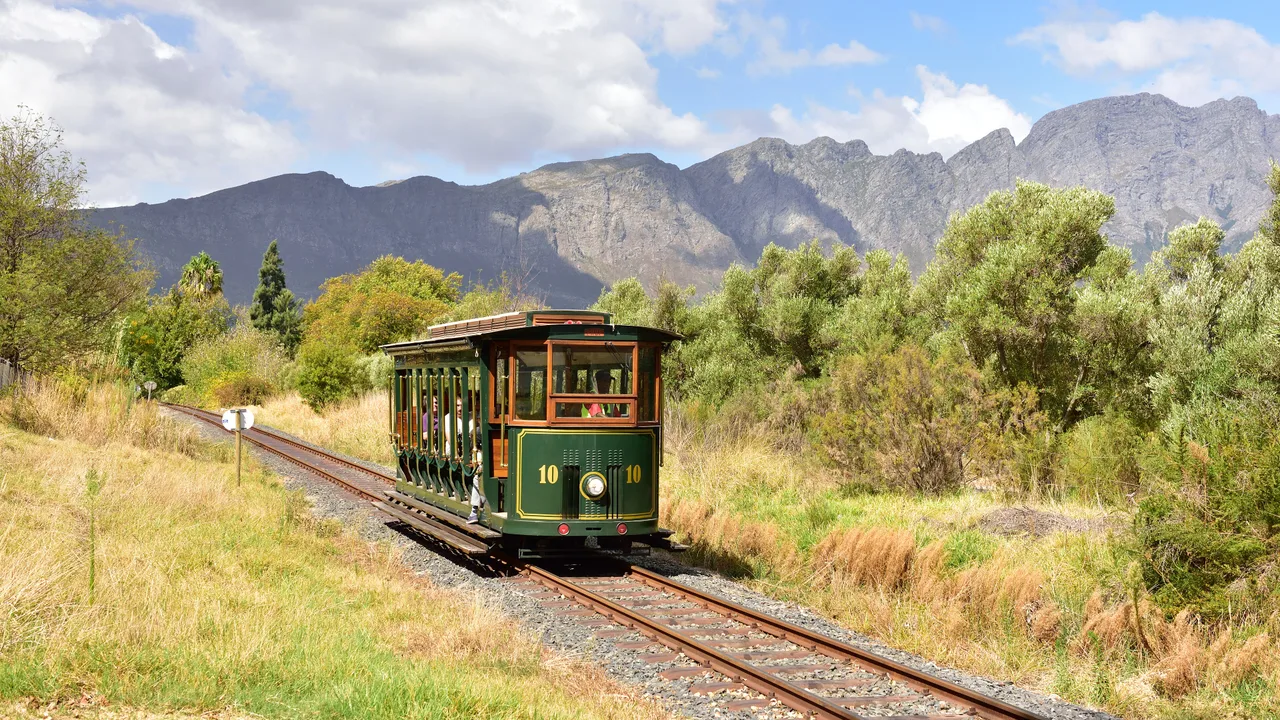
Treat the winelands as three separate day trips, not one: Stellenbosch for the easiest run from Cape Town, Franschhoek if you want the Wine Tram and a long lunch, and Paarl for a quieter day with a mountain and a monument. Whichever you pick, settle how you’ll get home before you taste anything, because South Africa’s drink-driving rules may soon get stricter and the tram and the tasting rooms wind down by late afternoon.
The towns lie inside an hour or so of Cape Town, which makes them an easy day out from the city, or a night or two if you’d like to taste without watching the clock. They are one corner of the Western Cape, which takes in the Cederberg to the north and the Garden Route to the east. Prices and hours below were checked on 16 November 2026.
Three towns, three kinds of day
| Town | Distance from Cape Town | What it suits |
|---|---|---|
| Stellenbosch | About 50 minutes from the city centre | A walkable town, then estates on the edge of it; the shortest trip |
| Franschhoek | About an hour; 75 km by road from the city centre | A small village of restaurants, with the Wine Tram through the valley |
| Paarl | A little over an hour | Hiking on Paarl Mountain, the Taalmonument and large cellars |
The Stellenbosch figure and the “about an hour” and “a little over an hour” come from Cape Town Tourism’s neighbourhood guides; the 75 km is the road distance from the city centre, the same figure the Garden Route in 10 days uses. Drive times vary with traffic and the day of the week, so allow extra on a Friday afternoon.
Getting there from Cape Town
A car is the simplest way to cover more than one estate, and the road is a main route. Metrorail brought back a limited service to Stellenbosch in March 2024, but check PRASA’s notices before you trust a timetable. For the other towns, a guided tour, an e-hailing car or a hired driver is a more reliable bet than public transport.
Plan the day around your ride home, not the other way round: tasting rooms such as Spier and Boschendal take their last seatings in the late afternoon (their hours are below), so a 17:00 finish is realistic.
Stellenbosch
Cape Town Tourism calls Stellenbosch South Africa’s second-oldest town, with wine estates, cafés, hiking trails and striking architecture, all about 50 minutes from the city centre. It suits you if you’d like the day to start with a stroll and a coffee, and then move to one or two estates rather than five.
Spier, an estate in the Stellenbosch area, publishes its own tasting menu, read on 16 November 2026: A Taste of Spier is R105 per person, the Winemaker Selection R150, and the Cellar Collection R220. Tastings run daily from 09:30, the site is open 09:00 to 17:00, and in the 1 October to 30 November window it closes at 18:00 from Thursday to Saturday. From 1 December 2026 to 15 January 2027 Thursday to Saturday hours extend to 19:00, with the last tasting at 18:00. Outside those two windows the standard 09:00 to 17:00 applies every day.
Franschhoek and the Wine Tram
Franschhoek is a small village in a valley ringed by mountains, about an hour from Cape Town, and it’s built for eating: Cape Town Tourism’s guide puts its restaurants first, then chocolate and a motor museum.
The Franschhoek Wine Tram is a hop-on, hop-off service, and the reason many visitors come. Its website lists the hop-on, hop-off ticket at R370 per adult and R90 for a child aged 3 to 17 on 16 November 2026, with no dates stated for those prices. You choose a colour line and the estates on it. Tastings and meals are extras, bought as you go. Five lines are listed: Red, Blue and Pink leave from Franschhoek Terminal at the corner of Main Road and Cabriere Street, and Orange and Green from Groot Drakenstein Terminal, at the corner of the R310 and R45.
The timetable the operator published in June 2026 shows trams leaving Franschhoek Terminal every half hour from 09:30 to 17:30, with a tram-bus connecting the farther estates; the Orange and Green lines leave Groot Drakenstein hourly from 09:14. The page doesn’t state operating days, so look at the booking calendar for your date. It also warns that Mont Rochelle and Haute Cabrière are being renovated, which affects the Red Line, and that roadworks near Franschhoek, Simondium and Klapmuts can cause delays. Book through the operator at winetram.co.za.
The tram takes the drive between tastings off your hands, which is its real appeal. It is also a slow way to see the valley. A day on it is about two or three estates and a proper lunch, not a tour of ten. Each line has its own list of estates, some shared: the operator lists the Red Line as Mont Rochelle, Haute Cabrière, Lynx, Eikehof, Rickety Bridge, Grande Provence and Franschhoek Cellar, and the Blue Line as La Bri, Holden Manz, Maison, Paserene, Klein Goederust, Grande Provence, Franschhoek Cellar and Rickety Bridge. The renovation notice names Mont Rochelle and Haute Cabrière, and of the five lines only the Red Line stops at either of them.
Paarl
Cape Town Tourism’s Paarl guide puts Paarl just over an hour’s drive from the city, and it’s the winelands day with a mountain in it. The Paarl Mountain Nature Reserve has a 5.1 km trail to Paarl Rock along a gravel road, and the same Cape Town Tourism guide describes a short climb to Bretagne Rock of 15 to 20 minutes. On the mountain you’ll find the Taalmonument, the Afrikaans Language Monument, designed by Jan van Wijk. The KWV cellar complex spans more than 22 hectares and runs tastings, including a brandy tour.
Tastings and booking
Fees differ by estate and by menu, and many want a booking. Boschendal, in the Franschhoek valley, says pre-booking and pre-payment are required for its Cellar Door and Manor House tastings, with walk-ins welcome subject to availability, and that the Cellar Door is open 09:30 to 16:30 daily. It adds a 10 per cent gratuity automatically for groups of five or more. Book the estate you most want first, then fit the others around it, and keep a gap of an hour or so between bookings.
Also check what the price includes. A fee that covers a food pairing is a meal; one that covers five wines is a flight. For the dishes behind the menu names, from bobotie to koeksisters, see South African food.
Drinking and driving
This is the part to read twice. The legal limit for general drivers is 0.05 g per 100 ml of blood, or 0.24 mg per 1,000 ml of breath, according to SAnews, the government news service, reporting in January 2026; it is a criminal offence to exceed it, and professional drivers face stricter limits of 0.02 g and 0.10 mg.
The Department of Transport wants to go further. On 2 September 2026 Transport Minister Barbara Creecy said the government is pursuing a strict zero blood-alcohol policy through changes to section 65 of the National Road Traffic Act, and that it aims to secure Cabinet concurrence by the end of 2026. The change hadn’t become law on the date SAnews reported it, but if you’re travelling in 2027, check again. The same report says more than 18,000 people were arrested for drunk driving between March and the end of August 2026, a third of all traffic arrests in the period. This is a summary of the published rules as of 16 November 2026, not legal advice.
So the plan is simple: the driver doesn’t taste.
Age rules matter too. Under the Liquor Act a minor is anyone under 18, and the national norms and standards for licensed premises say that age should be verified by an identity document, passport or driving licence, and that a person who refuses to show identification is treated as under 18 and told to leave. Carry photo ID to a tasting.
Driving yourself
South Africa drives on the left. The UK Foreign Office (FCDO), in advice checked on 16 November 2026, is cautious about roads in general: fatal accidents are common, especially at weekends and on public holidays. It advises drivers to avoid unfamiliar areas and be extra vigilant at night, keep fuel above half a tank, keep windows closed at junctions and keep valuables out of sight, ideally in the boot. It describes carjacking as common, particularly after dark, and says to surrender your vehicle if asked rather than resist. In the winelands, that argues for daylight driving and a return before dusk.
The Garden Route in 10 days by car uses the same roads and rules once you leave the Cape, and the Table Mountain cableway guide is worth reading if you want to fit the mountain around a winelands day.
If you have one day
Without a car, join a guided tour, or take a ride to Stellenbosch, walk the town and book one estate for lunch. With a car and a sober driver, take Stellenbosch in the morning and an estate near Franschhoek in the afternoon, finishing by 17:00. With a taste for the tram, give the whole day to Franschhoek and keep Stellenbosch for another trip.
Photos
Read also

Regions · 7 min read
Western Cape: Winelands, Overberg, Weskus, Garden Route
Updated · 17 November 2026Choose a Western Cape base by distance: Hermanus 119 km, Franschhoek 75 km, Knysna 531 km via Hermanus, plus Weskus, Cederberg and Karoo trade-offs.

What to see · 6 min read
Boulders Beach Penguins: Boardwalk, Beach and Tickets
Updated · 17 November 2026Boulders penguins: R282 adult fee for overseas visitors, card-only gate, hours, 40 km from Cape Town, the Foxy Beach boardwalk and the steep beach ramp.

Towns · 8 min read
Cape Town Travel Guide: Areas, Mountain, Beaches, Safety
Updated · 17 November 2026Cape Town for first-timers: where to base yourself, the Table Mountain cableway at R475, Bo-Kaap, the Waterfront, beaches, day trips and safety notes.

Car hire · 9 min read
Car Hire in South Africa: Documents and Road Safety
Updated · 17 November 2026Choose a hire car for South Africa, check the licence and payment terms, understand damage liability and plan left-hand driving and safe arrivals.