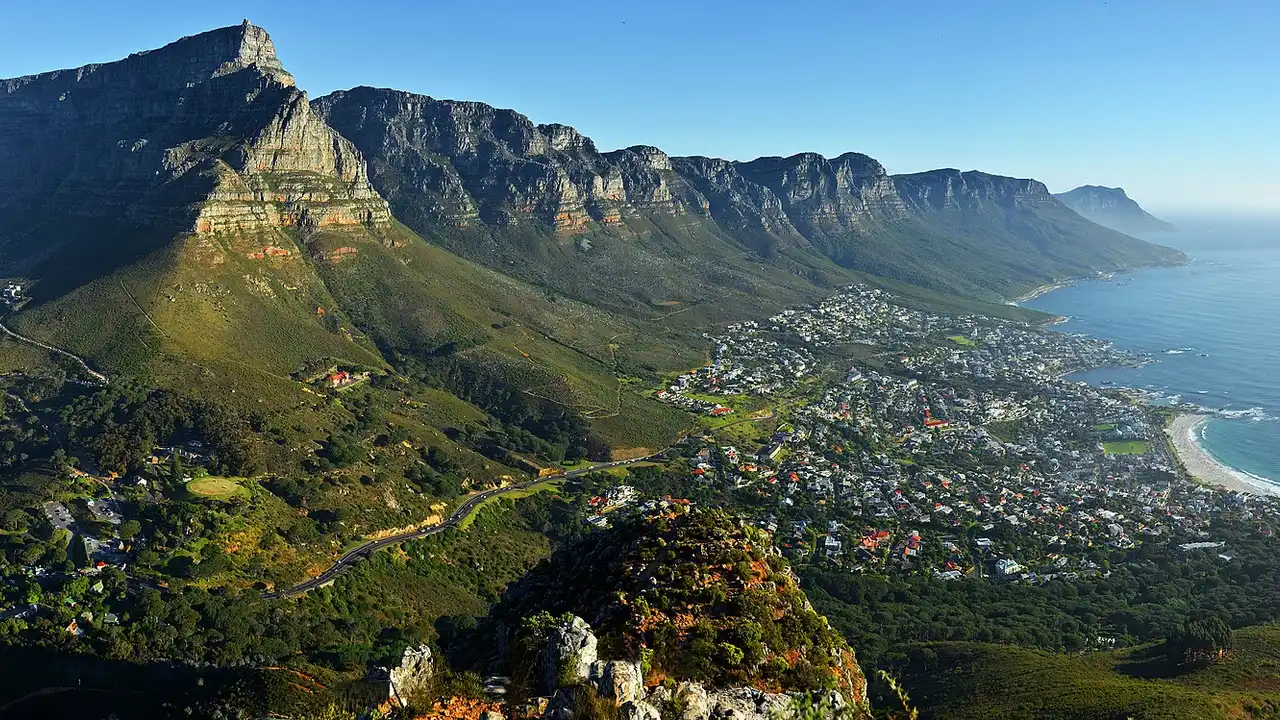
The Western Cape is big enough that the first decision is a direction, not a list of towns. Wesgro, the province’s tourism agency, splits it into six visitor regions: Cape Town, the Cape Winelands, the Overberg, the West Coast (Weskus), the Garden Route and Klein Karoo, and the Cape Karoo. Franschhoek is 75 km from Cape Town and Hermanus 119 km, so both work from a city base; Knysna, 412 km beyond Hermanus, doesn’t.
Pick by what you want from the days: wine and food in the Winelands, whales and reserve walks in the Overberg, a lagoon and small coastal towns on Weskus, sandstone hiking in the Cederberg, or the open Karoo. Distances below are by road from central Cape Town, without traffic.
Starting from Cape Town
Cape Town International Airport is a natural arrival point for a trip centred on the province. The city also gives you a base for the mountain, urban neighbourhoods and the Cape Peninsula before you move inland or along the coast. Start with the Cape Town guide and choose an area that fits how you’ll get around; city days rarely need a car, and the collection can wait for the day you leave.
The peninsula fits the Cape Town days too: the False Bay towns, the Boulders penguins and Cape Point fill a coastal day from the city. For the penguins at Simon’s Town, 40 km from the centre, the Boulders guide has the fee and the boardwalk; for whales and sharks along the Overberg coast, see the Hermanus and Gansbaai guide. To add Kruger to a Cape trip, the 14-day itinerary flies there from Gqeberha.
East through the Winelands and Overberg
The Cape Winelands offer an easy change of emphasis: mountain valleys, wine estates and towns including Stellenbosch, Franschhoek and Paarl. If wine and food are the point of the trip, you’ll want at least a night there. The Cape Winelands guide helps narrow those choices; start with the kind of day you want, a town-based stay, a tasting-led outing or a long lunch, then organise transport that suits it. A hire car is for moving between regions; on a day of wine tasting, someone else should do the driving.
The Overberg sits between the Cape Peninsula and the Garden Route, and Wesgro names Hermanus, Elgin and Swellendam among its bases. Further south, the Overberg runs out at Cape Agulhas, 224 km from the city and about 2 hours 50 minutes by road, where SANParks places the southernmost tip of the African continent and an historic lighthouse.
For a reserve-led coastal stay, look at De Hoop, 286 km from Cape Town and a drive of nearly four hours. CapeNature describes coastal trails and the dunes at Koppie Alleen as a whale-watching viewpoint, with fynbos and wildlife adding interest beyond the water. You’re going for the time outdoors, and a whale seen from the dunes is luck on top.
North towards Weskus, or inland to sandstone
The Cape West Coast, also called Weskus, gives you a different coastal journey. Langebaan, 125 km from Cape Town and about an hour and a half away, puts the lagoon at the centre of a stay; Paternoster, 149 km and about 1 hour 55 minutes, gives you a small-town coastal focus. These choices suit a traveller who wants to exchange city plans for time around the water and a slower sequence of outings.
Select the base around the experience. If the lagoon and nearby nature are your priority, keep your accommodation aligned with that. If a coastal village stay and meals are the point, allow time to remain in the village. The mistake is booking a quiet base and then spending every day driving away from it.
The Cederberg changes the trip again. Clanwilliam, in the Cederberg municipality, is 228 km from Cape Town, about 2 hours 40 minutes by road. CapeNature’s reserve description centres on sandstone formations, mountain fynbos, hiking and climbing. It deserves preparation for an outdoor stay: the trail, access road, accommodation and equipment need to match what you’re intending to do. CapeNature also requires at least three adult hikers for any Cederberg Wilderness trail, day or overnight, so a couple travelling on their own needs to plan around that rule before booking.
At the check on 16 November 2026, CapeNature was publishing Cederberg fire-and-flood access restrictions and temporary closures. Read CapeNature’s current notices for your trail and campsite before you pay for anything there, and again before you set off.
Choose Weskus for a coastal focus and the Cederberg for a mountain-led one. They can be combined, but the inland excursion changes both the equipment and the driving you need to plan.
The Garden Route and Klein Karoo
The Garden Route and Klein Karoo combine coastal places with inland options around Oudtshoorn, Calitzdorp and Ladismith. Knysna and Plettenberg Bay pull the trip towards estuaries, beaches and the coast; crossing inland changes the scenery and the rhythm of the days. Knysna is 531 km from Cape Town by way of Hermanus, a day of 412 km from Hermanus alone. Oudtshoorn is 420 km from the city, about 5 hours 15 minutes, and lies between the Swartberg and Outeniqua mountains, with CapeNature’s Swartberg Nature Reserve among the protected areas around it.
Use the Garden Route driving itinerary when this is the main journey you want. It gives the road trip a coherent shape. Gqeberha, where that itinerary ends, is 751 km from Cape Town by the shortest road, close to nine hours of driving, so plan the trip one way and fly on from there.
George Airport provides another way to approach this part of the province. Compare the flights available on your dates with the road journey and vehicle arrangements you prefer. Starting or finishing around George can be useful if your holiday priorities are already concentrated on the Garden Route and inland Klein Karoo.
Watch the provincial boundary when planning: the wider Garden Route journey and its national park reach into the Eastern Cape. That’s a useful extension to research, but it belongs in your itinerary as an extension. The Western Cape label shouldn’t hide how far you’ve chosen to travel.
The Cape Karoo
Cape Karoo choices include Prince Albert, 392 km from Cape Town and nearly five hours by road, Beaufort West, 462 km and a little over five hours, and Matjiesfontein. Plan a stay around a town, a reserve or time in the inland landscape, and let that interest decide the next stop.
Karoo National Park, near Beaufort West, is in the Western Cape. SANParks lists game drives, trails and other activities alongside the landscape itself. A reserve stay can give an inland journey its own centre of gravity, especially if you’d otherwise think of Beaufort West as somewhere passed on a long drive.
Keep the Cape Karoo distinct from the Klein Karoo in your planning. The names sound similar, but an Oudtshoorn-based visit and a Beaufort West or Prince Albert stay place you in different parts of the journey. For this sort of trip, accommodation location matters as much as its style: a remote property can be the reason to go, so build its access, meals and arrival arrangements into the booking. You’ll enjoy the open setting more when you can settle into it instead of driving straight out again.
How to split the nights
With seven nights, give Cape Town four, the minimum the Cape Town guide sets so that one day stays free for the cableway, then one in the Winelands and two in the Overberg. If the Overberg coast is the main attraction, see the Winelands on a day trip from the city and add that night to the coast instead of opening another base.
For a walking-led holiday, you might replace that eastern extension with the Cederberg. For a longer coastal road trip, give the Garden Route its own allocation. A quick test: look at each accommodation booking and name the experience you want nearby. If the answer is always somewhere else, reconsider the base.
The seasons matter as well: the Western Cape gets most of its rain in winter, which the before-you-go guide sets against Kruger’s dry season.
What works is booking in sequence: first the reserve, trail or activity that’s the reason for the trip, then the bed nearest to it, then the car for the days between bases.
Photos
Read also

Regions · 8 min read
Cape Winelands: Stellenbosch, Franschhoek, Paarl and the Law
Updated · 17 November 2026Cape Winelands from Cape Town: Stellenbosch, Franschhoek and Paarl compared, the R370 Wine Tram, tasting fees and drink-driving rules.

What to see · 6 min read
Boulders Beach Penguins: Boardwalk, Beach and Tickets
Updated · 17 November 2026Boulders penguins: R282 adult fee for overseas visitors, card-only gate, hours, 40 km from Cape Town, the Foxy Beach boardwalk and the steep beach ramp.

Towns · 8 min read
Cape Town Travel Guide: Areas, Mountain, Beaches, Safety
Updated · 17 November 2026Cape Town for first-timers: where to base yourself, the Table Mountain cableway at R475, Bo-Kaap, the Waterfront, beaches, day trips and safety notes.

Car hire · 9 min read
Car Hire in South Africa: Documents and Road Safety
Updated · 17 November 2026Choose a hire car for South Africa, check the licence and payment terms, understand damage liability and plan left-hand driving and safe arrivals.